
Giorgio Andreotta Calò: The project deboleFORTE and the Island of Sant’ Andrea in Venice
23 April – 19 July 2026
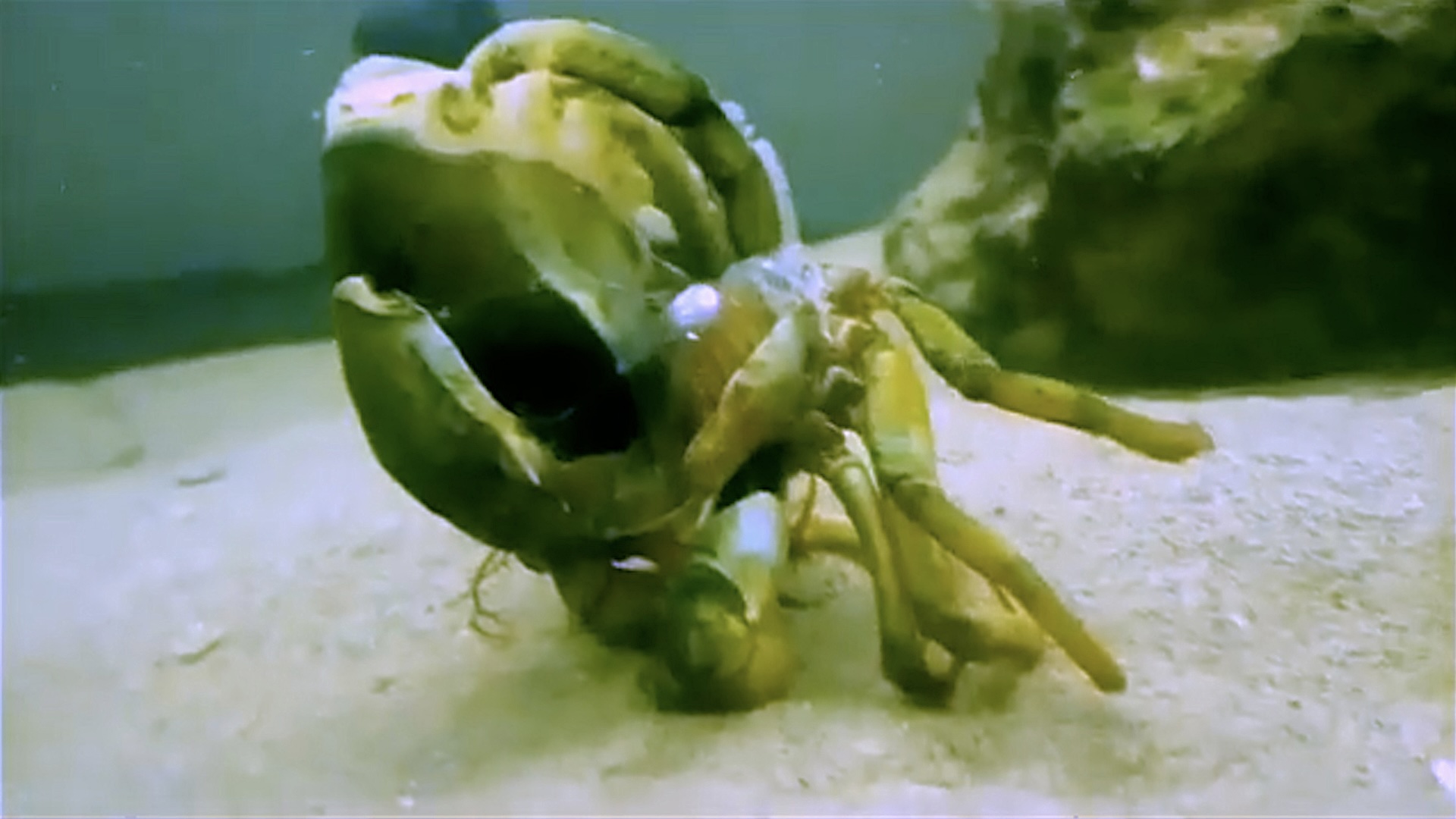
Giorgio Andreotta Calò, deboleFORTE (video still), © Giorgio Andreotta Calò, Courtesy the artist
Exhibition
As part of the Munich art festival “Various Others”, the ERES Foundation has invited the Italian artist Giorgio Andreotta Calò (b. 1979) to exhibit at the ERES Projects space this year. This international collaboration also serves as a bridge to this year’s Biennale Arte in Venice, in which the Foundation is participating as a Collateral Event with the group exhibition “Shifting Waters”. Two of the artist’s works will also be on display at the Fondazione ERES, situated between the Giardini and the Arsenale.
The atmospheric opening of the exhibition in Munich is set by the characteristic colour palette of the Venetian lagoon. Giorgio Andreotta Calò envelops the space beyond the window in a diffuse green. The fluid structure of the Venetian water landscape condenses into an immersive experience in which perception and spatial orientation are transformed.
The exhibition centres on the project deboleFORTE, which the artist has been pursuing on Sant’Andrea since 2023 in collaboration with a number of partners. The island near Venice plays a key role in this. Once built as a fortified Renaissance defence, it is now a fragile ecosystem characterised by erosion and constant change. It brings together the contrasts of stability and fragility, of historical establishment and natural change. The title deboleFORTE refers to this tension: ‘debole’ stands for ‘fragile’ or ‘weak’, whilst ‘Forte’ denotes both the fortress and the qualities of strength, resilience and perseverance. Giorgio Andreotta Calò conceives of the island as a place in transition, where resistance manifests itself within fragility.
This idea is visualised in the exhibition space as a moving image: the projection of a crab moulting, retreating into an old shell, serves as a precise metaphor for the state of the fort of Sant’Andrea – a moment of radical vulnerability that simultaneously enables transformation and continuity.
The exhibition is complemented by further works arising from the artist’s engagement with the lagoon. A bronze sculpture from the ‘Clessidra’ series embodies time in its hourglass-like form. Based on the wooden fragments of the “briccole“ – the posts used to mark channels or moor boats – eroded at their centres by the tides, these works allude to circularity, infinity and the principle of reflection. Reflection is a central motif in Giorgio Andreotta Calò’s work, both as an optical phenomenon of water and as a mental movement. And so the endangered “Pinna Nobilis”, an Adriatic mussel species cast in bronze, can also be read as a material archive in which ecological, geological and temporal processes are inscribed.
The artistic manifesto and extensive documentation on deboleFORTE offer an insight into the processual dimension of the work and make it clear that Giorgio Andreotta Calò’s practice is focused less on finished objects and more on ongoing investigations – on a way of thinking in terms of transitions and temporal stratifications. This visionary project is a participatory initiative that combines the protection of the site with a new, sustainable and cultural use, a laboratory for ideas of the future.
By transposing the conditions of the Venetian lagoon into the Munich context, the exhibition opens up a space for reflection on the resilience of the fragile in a dialogue across the Alps: on time, transformation and perception, and on that quiet yet constant force that lies in the state of in-between.
Presse
-
Weekender, Various Others 2026
Kunstforum International, 14. Mai 2026
Artikel als pdf